Guía del barrioNeighborhood guide
Coconut Grove
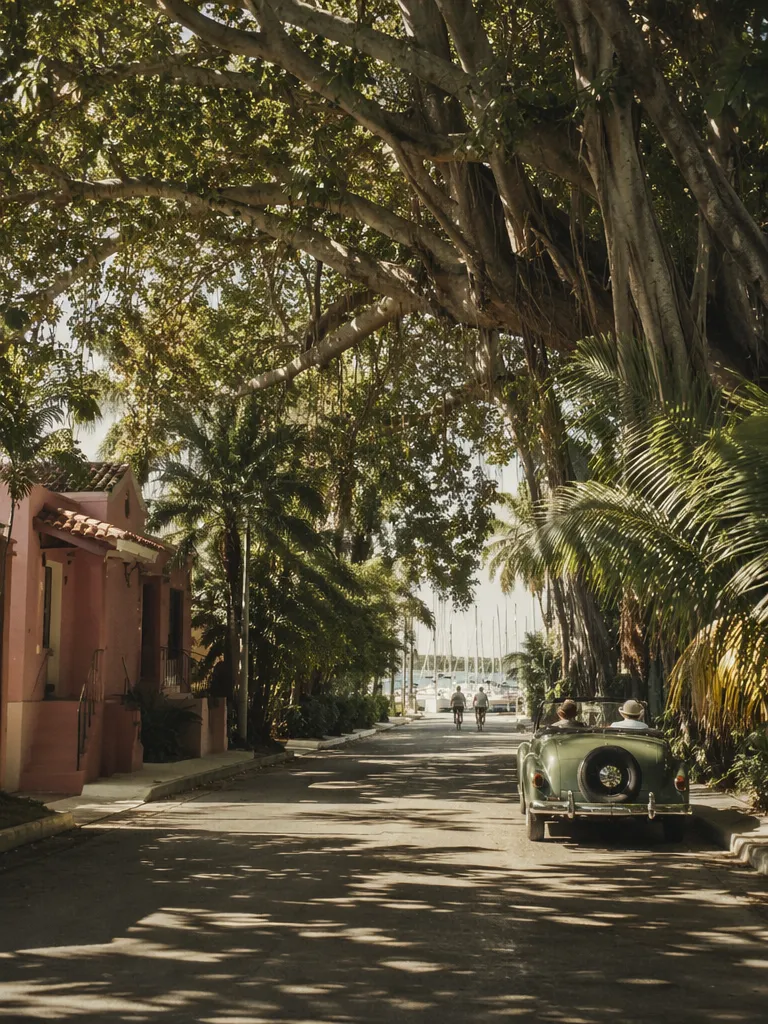
En Coconut Grove los banianos forman túneles sobre la calle y los mástiles de Dinner Key marcan el ritmo. Es el barrio más antiguo de Miami — y el menos apurado: aquí se camina a la sombra, se almuerza en una vereda y se termina el día viendo veleros en la bahía.In Coconut Grove, banyan trees form tunnels over the street and the masts at Dinner Key set the tempo. This is Miami's oldest neighborhood — and its least hurried: you walk in the shade, linger over a sidewalk lunch, and end the day watching sailboats drift across the bay.
Donde empezó MiamiWhere Miami Began
Antes de que Miami existiera como ciudad, aquí ya había vida. En 1873, Horace P. Porter abrió una oficina postal y la bautizó "Coconut Grove"; una década después los Peacock levantaron el primer hotel de la zona, donde hoy está Peacock Park, y los trabajadores bahameños que lo sostenían fundaron en los años 1880 el primer asentamiento negro del área: el West Grove, todavía conocido como Little Bahamas. Miami anexó el barrio en 1925, pero el Grove nunca dejó de sentirse un pueblo aparte, refugio de marineros, escritores y bohemios dentro de la metrópoli. Cada año, el Goombay Festival celebra esas raíces afrobahameñas con música y comida en el West Grove.There was life here before Miami was a city. In 1873, Horace P. Porter opened a post office and named it "Coconut Grove"; a decade later the Peacocks built the area's first hotel on the site of today's Peacock Park, and the Bahamian workers who kept it running founded the area's first Black settlement in the 1880s — the West Grove, still known as Little Bahamas. Miami annexed the neighborhood in 1925, but the Grove never stopped feeling like its own village, a haven for sailors, writers and bohemians inside the metropolis. Every year, the Goombay Festival celebrates those Afro-Bahamian roots with music and food in the West Grove.
Tres joyas con siglo de historiaThree Landmarks with a Century of Stories
Vizcaya Museum & Gardens (3251 South Miami Avenue) es la fantasía renacentista que el industrial James Deering estrenó en la Navidad de 1916: una villa frente a Biscayne Bay con diez acres de jardines formales que parecen traídos de Italia. Abre todos los días excepto martes, de 9:30 a 16:30 (precios en vizcaya.org). Más íntimo, The Barnacle Historic State Park conserva sobre Main Highway la casa de 1891 de Ralph Munroe, primer comodoro del Biscayne Bay Yacht Club, con su césped abierto a la bahía; el interior solo se visita en tour guiado. Cierra martes y miércoles; abre de jueves a lunes, de 9:00 a 17:00. Y The Kampong, en Douglas Road, guarda el jardín de nueve acres donde el explorador botánico David Fairchild aclimató 65 variedades de mango: se entra con reserva previa.Vizcaya Museum & Gardens (3251 South Miami Avenue) is the Renaissance fantasy industrialist James Deering unveiled on Christmas Day 1916: a villa on Biscayne Bay with ten acres of formal gardens that feel airlifted from Italy. It opens daily except Tuesdays, 9:30 a.m. to 4:30 p.m. (pricing at vizcaya.org). More intimate is The Barnacle Historic State Park on Main Highway, preserving the 1891 home of Ralph Munroe — first commodore of the Biscayne Bay Yacht Club — with a lawn that rolls straight down to the bay; the house itself is guided-tour only. It's closed Tuesdays and Wednesdays; open Thursday through Monday, 9 a.m. to 5 p.m. And The Kampong, on Douglas Road, keeps the nine-acre garden where plant explorer David Fairchild grew 65 varieties of mango: entry is by advance reservation.
La bahía: vela, parques y clippersThe Bayfront: Sails, Parks and Clippers
Dinner Key guarda la historia aérea más improbable de Miami: en los años 30, los hidroaviones Clipper de Pan American despegaban de aquí rumbo a Latinoamérica, y la antigua terminal es hoy el City Hall de la ciudad. La marina actual es la más grande de Florida en amarres húmedos, y el horizonte suele llenarse de velas — Regatta Park, justo al lado, toma su nombre de ellas. Unos pasos al norte, Peacock Park ocupa el terreno del hotel pionero de 1883, con canchas, parque infantil y césped que baja hacia el agua; David T. Kennedy Park completa la franja verde frente a la bahía. Es el tramo más fotogénico del barrio para caminar al atardecer.Dinner Key holds Miami's most improbable aviation story: in the 1930s, Pan American's Clipper flying boats took off from here bound for Latin America, and the old terminal now serves as Miami City Hall. Today's marina is Florida's largest wet-slip marina, and the horizon fills with sails — Regatta Park, right next door, is named for them. A few steps north, Peacock Park sits on the grounds of the pioneering 1883 hotel, with courts, a playground and a lawn sloping toward the water; David T. Kennedy Park rounds out the green ribbon along the bay. It's the most photogenic stretch of the neighborhood for a sunset walk.
Comer y beber en el GroveEating and Drinking in the Grove
El Grove come bien y sin estridencias. GreenStreet Cafe es la institución del brunch en la esquina de Main Highway y Commodore Plaza: no acepta reservas para brunch ni almuerzo (solo cenas desde las 5:30 p.m.), así que madruga. Dos estrellas Michelin conviven a metros: Ariete, donde el chef Michael Beltrán sirve su célebre canard à la presse, y Los Félix, mexicano de maíz molido en casa. Para mariscos con vista y música en vivo, Monty's Raw Bar sirve stone crab junto al agua desde 1969. Krüs Kitchen funciona como restaurante, mercado y tienda de vinos, Panther Coffee resuelve el café de la mañana, y en CocoWalk (3015 Grand Avenue) encuentras desde la pizza de Mister O1 hasta el helado de Salt & Straw, con el cine de lujo Cinépolis en el mismo complejo.The Grove eats well without shouting about it. GreenStreet Cafe is the brunch institution at the corner of Main Highway and Commodore Plaza — no brunch or lunch reservations (dinner bookings only, after 5:30 p.m.), so come early. Two Michelin stars sit steps apart: Ariete, where chef Michael Beltrán serves his celebrated canard à la presse, and Los Félix, a Mexican spot built on house-milled masa. For seafood with a view and live music, Monty's Raw Bar has been shucking stone crab at the water's edge since 1969. Krüs Kitchen doubles as restaurant, market and wine shop, Panther Coffee handles your morning caffeine, and at CocoWalk (3015 Grand Avenue) you'll find everything from Mister O1 pizza to Salt & Straw ice cream, with the Cinépolis luxury cinema in the same complex.
Práctico: cómo movertePractical: Getting Around
El centro del Grove es un triángulo caminable donde se cruzan Main Highway, Grand Avenue y McFarlane Road: todo lo esencial queda a 10–15 minutos a pie, casi siempre bajo la sombra de banianos — una bendición al mediodía, cuando el resto de Miami arde. Para llegar sin auto, toma el Metrorail hasta la estación Douglas Road y súbete al trolley gratuito de la ciudad, que baja hasta el corazón del barrio; la estación Coconut Grove también queda a una milla a pie. ¿En auto? Estaciona en el garaje de CocoWalk en vez de perseguir parquímetros. Vizcaya queda en el borde norte del barrio, junto a su propia estación de Metrorail, así que combina bien al inicio o al final del día.The heart of the Grove is a walkable triangle where Main Highway, Grand Avenue and McFarlane Road meet: everything essential sits within a 10–15 minute stroll, almost always under banyan shade — a blessing at midday, when the rest of Miami bakes. To arrive car-free, ride Metrorail to Douglas Road station and hop the city's free trolley down to the village center; the Coconut Grove station is also about a mile's walk away. Driving? Park in the CocoWalk garage rather than hunting meters. Vizcaya sits on the neighborhood's northern edge next to its own Metrorail station, so it slots neatly into the start or end of your day.
Esta semana en Coconut GroveThis week in Coconut Grove
Vizcaya Late: cine y libros de misterioVizcaya Late: Spooky Edition
Cine temprano, libros de misterio y decoración de calabazas en los jardines. Adulto $17.85 y niños de 6–12 $12.51 con cargos; menores de 6 gratis. Comida y libros adicionales aparte.Early cinema, spooky books and pumpkin decorating in the gardens. Adults $17.85 and ages 6–12 $12.51 including fees; under 6 free. Food and optional books cost extra.
Imperdibles de siempreAll-time essentials
Vizcaya Museum & GardensVizcaya Museum & Gardens
Un palacio veneciano de 1916 con jardines junto a la bahía que no parecen de este siglo ni de este país. El rincón más fotogénico de Miami.A 1916 Venetian-style villa with bayside gardens that feel lifted from another century and continent — Miami's most photogenic corner.
Preguntas frecuentesFrequently asked
- ¿Es seguro Coconut Grove?Is Coconut Grove safe?
- Sí: es uno de los barrios más tranquilos y familiares de Miami, con mucha vida peatonal de día y de noche en el centro. Aplica las precauciones normales de cualquier ciudad grande, sobre todo en calles poco iluminadas ya tarde.Yes — it's one of Miami's calmest, most family-oriented neighborhoods, with plenty of foot traffic in the village center day and night. Use the same common-sense precautions you would in any big city, especially on quieter streets late at night.
- ¿Cómo llego a Coconut Grove?How do I get to Coconut Grove?
- En transporte público, toma el Metrorail hasta Douglas Road y de ahí el trolley gratuito de la ciudad hasta el centro del Grove; la estación Coconut Grove queda a una milla a pie. En auto, entra por US-1 y estaciona en el garaje de CocoWalk.By transit, ride Metrorail to Douglas Road and catch the city's free trolley into the heart of the Grove; the Coconut Grove station is also about a mile's walk away. By car, come in off US-1 and park in the CocoWalk garage.
- ¿Cuánto tiempo necesito para visitar Coconut Grove?How much time do I need in Coconut Grove?
- Medio día alcanza para el centro, The Barnacle, los parques de la bahía y un buen almuerzo. Suma otro medio día si quieres Vizcaya y The Kampong con calma.Half a day covers the village center, The Barnacle, the bayfront parks and a good lunch. Add another half day if you want to do Vizcaya and The Kampong without rushing.
- ¿Coconut Grove es bueno para ir con niños?Is Coconut Grove good for kids?
- Mucho: Peacock Park tiene parque infantil y césped frente a la bahía, The Barnacle es una excursión corta y barata, y en CocoWalk hay helado de Salt & Straw y cine. Los jardines de Vizcaya también funcionan muy bien en familia.Very — Peacock Park has a playground and a bayfront lawn, The Barnacle makes a short, cheap outing, and CocoWalk has Salt & Straw ice cream and a movie theater. Vizcaya's gardens work beautifully with kids too.
- ¿Qué se puede hacer gratis en Coconut Grove?What can I do for free in Coconut Grove?
- Caminar bajo los banianos de Main Highway, recorrer los parques frente a la bahía (Peacock, Regatta y Kennedy), ver los veleros en Dinner Key y moverte en el trolley de la ciudad. The Barnacle cuesta apenas ~$2 la entrada al parque.Walk under the banyans on Main Highway, roam the bayfront parks (Peacock, Regatta and Kennedy), watch the sailboats at Dinner Key and ride the city trolley. The Barnacle's park entry is only about $2.
- ¿Por qué el City Hall de Miami está en Coconut Grove?Why is Miami City Hall in Coconut Grove?
- Porque ocupa la antigua terminal de los hidroaviones Clipper de Pan American, que en los años 30 volaban desde Dinner Key hacia Latinoamérica. El edificio conserva su encanto de época frente a la marina y se puede ver por fuera al pasear por el malecón.Because it occupies the former terminal of Pan American's Clipper flying boats, which flew from Dinner Key to Latin America in the 1930s. The building keeps its period charm beside the marina, and you can admire it from outside on a bayfront stroll.